STUDIO+SPACE project gallery...

8.12.09

Visual Essay: The Winners

We are glad to finally announce the winners of the Visual Essay competition.
Since we received so many wonderful pictures, the team decided to choose 4 images, according to the votes and the characteristics the pictures should have, and that graphically are appropiate for an "end of the year" card.
This images will be available as cards on the arch-peace site on a few days for all the members to enjoy and use as will.

11
Old Door, by Marwa Yousef, Palestine
taken in Birzeit, Palestine


60
by Judith Vargas Araya
taken in Valparaíso, Chile


10
by Gabriela Sabadini, Chile
taken in La Serena, Chile


17
by Susanne Bruecke
taken in Havana, Cuba

12.11.09

Visual Essay, the voting procedure

First and foremost, as Arch-Peace we thank all of you that participated in any way on this event, whether sending pictures or promoting it within your contacts and colleagues.

Now is the time for you to vote, we are looking for images that are graphically appropriate for an "end of the year" card (season's greetings). This means that it has to have the right balance between meaning and hope, according the Arch-Peace principles and ideals.

The images are now with a number, now have to vote for the top ten images that for you have what it takes to become the greeting card for this year.

You can cast the vote commenting here, through the Facebook event created to vote or sending a mail to gabriela@architectsforpeace.org.

6.11.09

Visual Essay

Visual essay is a new category among our news. Members are invited to submit original photographs of their city/town or other visual clues on urban or architectural character. Among the submissions we will chose an image for our end of the year card (with due credit to the author).

Now we invite you to keep sending pictures, the deadline is November 8th at gabriela@architectsforpeace.org , or to vote to choose the winner.

You can find more details here.

9.5.09

<----- <----- <----- ToY -----> -----> ----->

BORDERS
where do they startsmarter we become = produce high technology high borders
better materials worse borders


Maybe i will live for a short time but i can't develop this way


Architects for better solutions

25.4.09

* WORKSHOP KOSOVA : “Ecologies of Identity”

BAD-INN (University for Business and Technology in Prishtina, Kosova) invited BAD-MIL/Lorenzo Bini (Politecnico di Milano) with Prof. Gennaro Postiglione to lead a joint-workshop in Pristina, during November 2008. 5 students from Milan, Italy and 10 students from Pristina, participated in this urban design workshop.

The idea is to work on the complex topic of “building” a national identity of Kosovo and its consequences for the urban development of Prishtina and the whole Kosovo. The framework is the recently declared independency of Kosovo from Serbia and the need to build its own identity in order to proceed with the international discussion. A clear and visible identity is vital if you need to assert your country in relation to other countries. This is a consequence of a long term policy dating from last century where the idea of Nation & State was gathered together bringing also the theme of ethnicity.

The following documents cover some of the topics discussed during the workshop:

  • Ecology of Narration [PDF]
  • Ecology of Network [PDF]
  • Ecology of Heritage [PDF]
  • Ecology of Buildings [PDF]
  • Ecology of Borders [PDF]

19.4.09

Playing on Freeways

By Anthony McInneny

Since 2005 Anthony McInneny has been a studio leader in the RMIT Art in Public Space program. In 2008 he was appointed as the coordinator of the Graduate Certificate in Public Art, Art in Public Space.


15.10.08

AMRIK..."Mobile History"

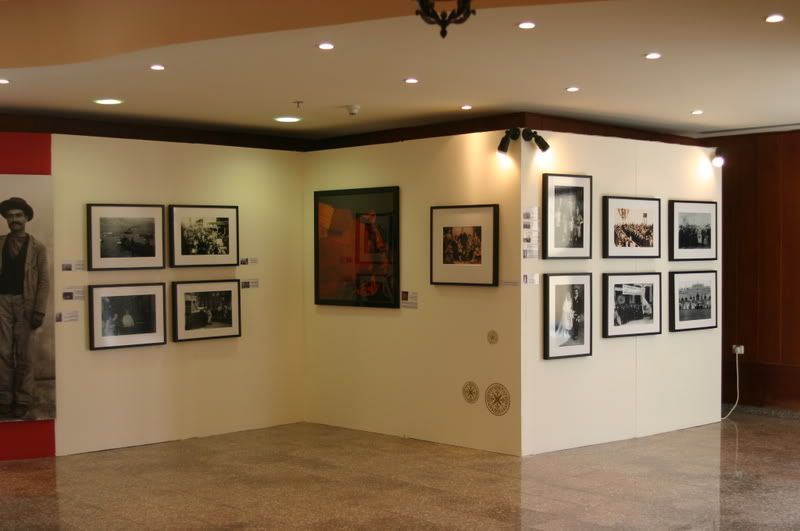
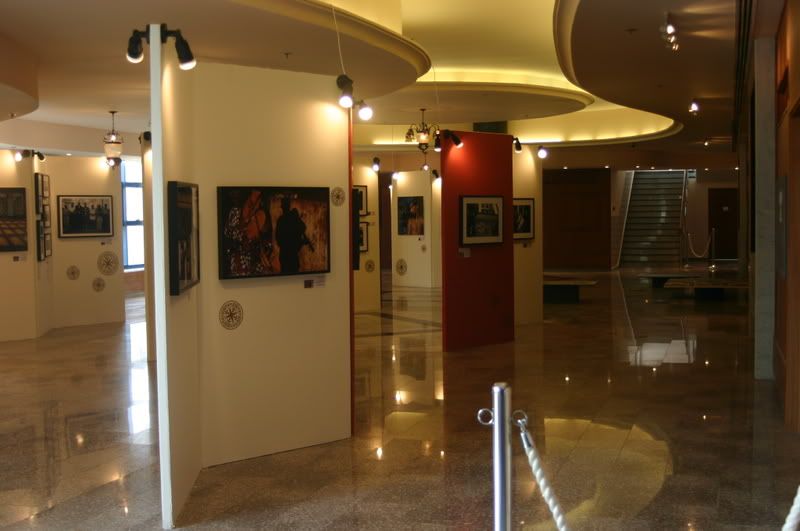
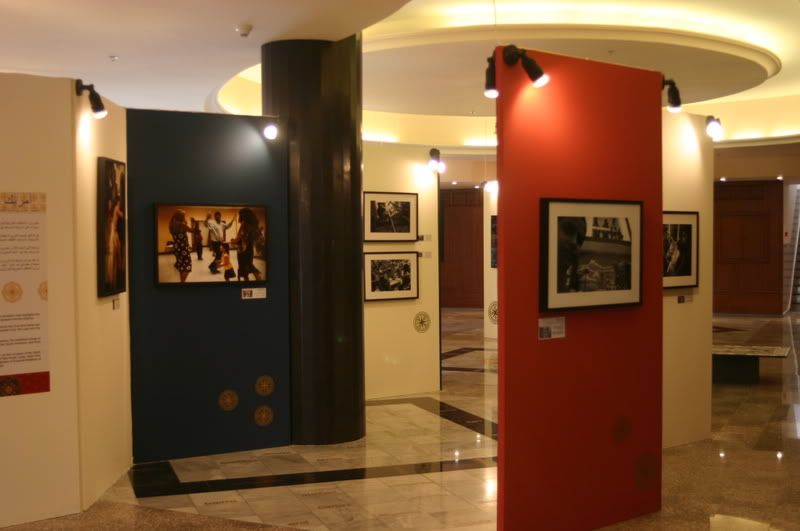
AMRIK...A photography show to show the presence of Arab in South America
i had the chance to be part f it ,in organizing the show in ramallah ,Palestine
accompanied by the Brazilian architect who worked on the idea from the start
the pictures are just amazing

The pictures captured Arabs who immigrated to South America in the late 19th -20th century
they are now integrated the society,speak the language and have one of the most successful companies


The pictures were made by 23 photographers from ten countries in South America, all recent, except for the historic pictures. The exhibition is divided into four moments. The first shows the cultural presence of the Arab habits brought from abroad.

Then, the pictures show immigrants going through difficult moments when leaving their country. Then come images that show Arab and South American integration, and last of all comes the Arab identity.

I had the chance last February ..and Beatriz had the chance to visit it in Chile and Jordan this is just a great coincidence. If you want to know more about this exhibition go to http://www.exposicoes.mre.gov.br/amrik/default.html
thanks

28.9.08

what is trespassing to you?

By Beatriz C. Maturana

At our last committee meeting, we had a very interesting discussion around the notion of 'trespassing' after which, and as suggested by Peter Johns, we decided to focus on trespassing for our next words @ bldg50.

The discussion was prompted by very real concerns around one of our pro bono project in which our ‘clients’ are actual squatters. So the question was: what is trespassing for Architects for Peace, is it something we take on, is it what we are…? After all we trespassed notions of ‘nationalism’, ‘patriotism’, fear of ‘terrorism’ and many other such notions when we took a stance against the war in Iraq. Since then, we have proudly trespassed many government decisions by openly and actively opposing them. For instance, on indigenous housing and land issues, on asylum seekers, on the continuation of the attack and occupation of Iraq, on the Kyoto protocol, on public transport and so on… Perhaps we might conclude that we stand for trespassing!

So, I would like to invite you to a visual exhibition which I will start. The question is:
what is trespassing to you?

This of course will lead to our next http://www.architectsforpeace.org/seminars.php in November 08 called 'trespassing'. There are no limits to the form that your view of trespassing may take, and the only rule is that it has to somehow connect to the built environment. So it is up to you, from silly to serious all views are welcome. I will start with the following photograph I have called “corny”, which in my view trespasses taste and imagination, and makes me smile.


Note: To add your image, please link your blog/post to this post by using the link option below. Otherwise send us an email with your image and a few explanatory words. Note that by doing this you accept that your image and words can be used in this website and/or at Architects for Peace presentations (with due acknowledgment).

19.5.07

Spencer Tunick in Mexico City


Karla Saenz, artist and member of Architects for Peace, was present in the zocalo of Mexico city for the latest installation of photographer Spencer Tunick - famous for his dramatic portraits of mass nudity in locations around the world.


In Karla's words...

I would say: Mexico in freedom!

Mexico and my heart are celebrating this event because Tunick showed the true power of public art; giving people a space of self-expression and freedom in many senses.

I was surprised to see almost 20 000 people participating. From the 6th floor of the Hotel Majestic the view was marvelous; some of us had tears in our eyes. The beauty of hundreds of exposed, vulnerable bodies created an atmosphere of unity, sheltered by the tenuous light of the sunrise.

The experience left me with a feeling of pride and many questions about human relationships…why should a thin layer of clothing and our preconceptions of the world make us so different from one another in our daily lives? Why can we not respect each other? Why are we not open for dialogue? To me it also shows how much we need spaces where we can be listened to.


29.4.07

September 2007 - Building in Thailand with Habitat for Humanity

In September 2007 Lucinda Hartley from the architects for peace pro-bono team together with her husband Tim will be leading a group of 11 Australian volunteers to northern Thailand to work with Habitat for Humanity on a short term building project. We will be working in partnership with local families to build one or more houses.


Habitat for Humanity International is a non-profit, housing ministry seeking to eliminate poverty housing and homelessness from the world, and to make decent shelter a matter of conscience and action. Habitat volunteers have built homes together with more than 125,000 families in need in 87 countries. Habitat works with in partnership with local communities and through volunteer labour and donation of materials. It is not a give away program rather it seeks to empower local communities through its micro finance program.

It is the responsibility of the international volunteer teams to raise the funds to finance the building project we contribute to. Our team has a fundraising target of $AUD15,000. This will finance the cost of building materials and tools, and make a contribution to the regional project.

If you would like more information about the project, or are interested in making a contribution, please contact mailto:hinfo.habitat07@gmail.com.

21.3.07

Architectural | Urban Space Design Studio

Architectural + Urban Space Design Studio
an invitation for the old, the young, the poor, the rich and all non-human beasts...

"Utopia is on the horizon: when I walk two steps, it takes two steps back. I walk ten steps and it is ten steps further away. What is utopia for? It is for this, for walking". Eduardo Galeano


For the last two years, I have run a 4th year architectural/urban design studio. In this studio, architecture is not the focus, but the result of urban, environmental and social considerations - and this is where we start. The studio focuses on the needs of the city, with architecture there to assist. These are human needs and those of non-human beasts, ecological needs - these needs know boundaries.

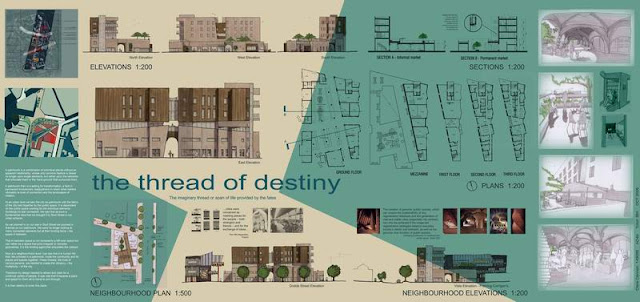
The following projects display the work of my University of Melbourne' students, from the last two semesters (2006). In both occasions, we have worked with the support and collaboration of two municipalities, the City of Knox and the City of Melbourne. These are actual sites and the students have worked towards resolving existing urban issues.

In the studios we spend the first two weeks learning about the city - strange as it may sound, some of the students had not spent time learning about their own city in Melbourne Australia. Therefore, for 2 weeks we met, discussed and worked in the public realm of Melbourne's civic centre.

Studio cross-disciplinary approach: An important feature of these studios has been its multidisciplinary and cross-university approach. For the Knox City project, for about half of the semester, students from RMIT public art and students from the University of Melbourne architecture, worked together visiting the site, preparing site analysis and initial urban proposals. This mixing not only provided a richer understanding of the problematic of the city, it also created the opportunity to learn from a different disciplinary perspective and to widen the scope for cross-disciplinary empathy.


The students - sometimes acting as hosts other times as guests - did their best to welcome their guest students. It was interesting to see how this process made it much easier and faster for everyone to feel at ease in this studio. Whether this was because there were not inner competitions - as both groups knew something the others did not know (and that was ok and fun) - is yet to be tested.


1. Southbank
An invitation for the old, the young, the poor, the rich and non-human beasts...
city-street-market-plaza-house-citizen: agenda for a living walking city…


“From Perikles' Athens to David's Paris, the word 'civic' has implied an intertwined fate, a crossing of fortunes. It was inconceivable to a Periklean Greek that his or her fortune could be separated from the fortunes of a city, or to a pagan Roman of Hadrian's time.” R. Sennett (1994)


Project:
Urban proposal and architectural design for a mix of public and private spaces, with residential and community or commercial buildings. The final proposal will cover an extension of approximately one square block of the Southbank area within “The Sturt Street cultural spine”.

Location:
Bounded by the Yarra River, Westgate Freeway, Kings Way, Dorcas Street and St Kilda Road


  • top of page image: Clare Cannon
  • image 2: Minh Ngyuen
  • image 3: Dominic Kao
  • image 4: Ka-Wai Wong and team
  • image 5 (presentation under the freeway): Anna and Libby
  • Image 6 (presentation under the freeway): Minh, Emily and Clinton
  • Image 7 (presentation under the freeway): by Minh, Emily and Clinton

2. KNOX CENTRAL
This balancing act aims to rise above exclusive economic agendas. An invitation for the old, the young, the poor, the rich and non-human beasts...
city, street, markets, squares and houses: transcending the shopping spectacle…


"Why are you so interested in these houses?" one of the Turkish dwellers asks me, "they are ordinary". There it is, the fundamental question in its lucid form: why would these countless, repetitive, identical houses for the workers inspire anyone to explore their architectural significance? Yet, a few minutes later, she admits that the roof terrace of their building is "very beautiful and uncommon". Esra Akcan, The "Siedlung" and the "Mahalle"


Project: medium density housing:
The housing project will emerge from a thorough understanding of its suburban circumstance. The objective is to identify current development agendas and propose new ones to ensure and facilitate a multiplicity of uses with a strong social and ecological programme.

Location:
Knox Central is the working name given to a core area of commercial and industrial land located along the Burwood Highway between Stud and Scoresby Road, Wantirna South / Knoxfield.


  • image 1: Darren Kim Lee Yio
  • image 2: Group work

Studio leader: Beatriz C. Maturana
Beatriz is an architect with a masters of Urban Design, she is currently a PhD candidate at the University of Melbourne. Her architectural work includes local government buildings such as childcare centres, maternal and child health, sport pavilions and residential and urban design projects.

Team leaders: Prof Greg Missingham (Knox City) and Dr Darko Radovic (Southgate)

26.9.06

Crawl Before You Walk

The following work is part of a forthcoming partnership public art project (working title Crawl Before you Walk) between Architects for Peace, RMIT Public Art and one Melbourne University's architectural design studio. Works will be located beneath the Kings Way overpass, at the corner of City Road, Queensbridge Road and Kings Way, to be held on one night only on Monday 23 October, coinciding with the Walk 21 Conference.


“IMAGES DETACHED FROM every aspect of life merge into a common stream, and the former unity of life is lost forever. Apprehended in a partial way, reality unfolds in a new generality as a pseudo-world apart, solely as an object of contemplation…The spectacle in its generality is a concrete inversion of life, and, as such, the autonomous movement of non-life.” G. Debord (1967)

Jaguar Lacroix is a new media artist whose work considers the paradox of modern life. She is concerned with the abject and the detached and the connection between this detachment and the necessarily irreconcilable notion of our complicity or culpability in this hopelessness.

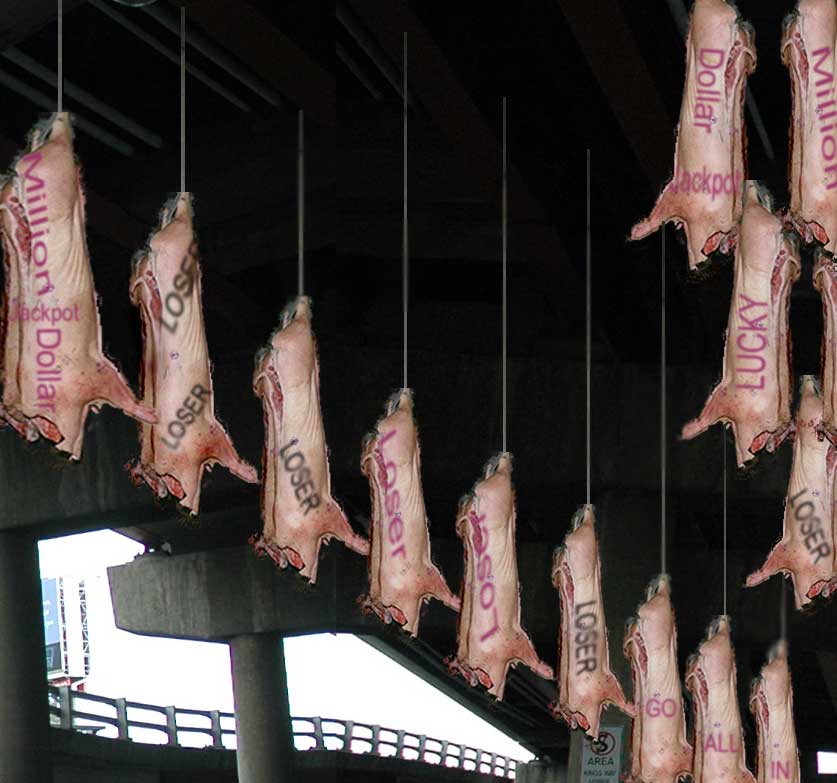
Abattoir of Dreams presents two concepts set in the non-place beneath the appropriately named Kings Way overpass, at the back of the Crown Casino that is the built form of government’s addiction to gambling both metaphorically and financially. In Victoria, gambling is approaching 18% of State revenue.
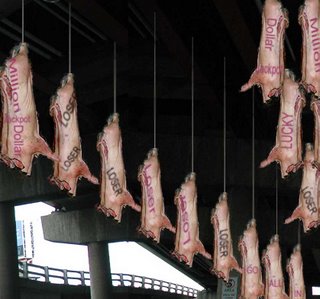
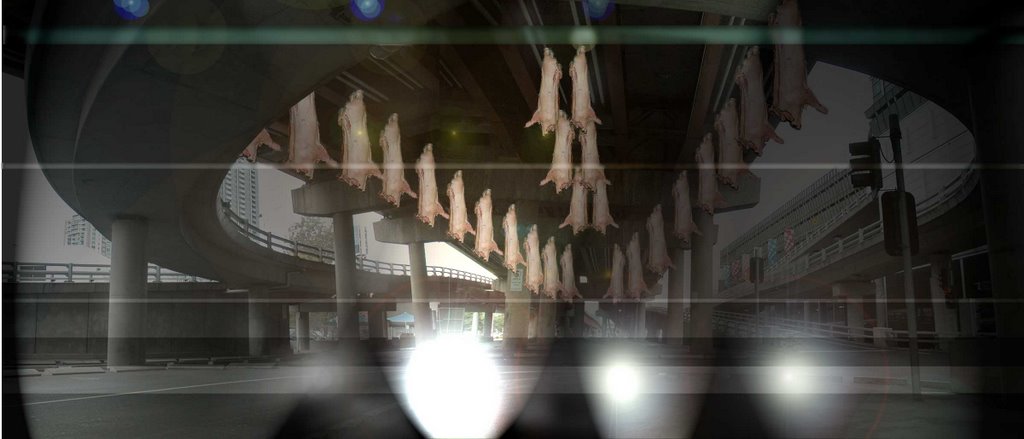
Abattoir of Dreams – detail. Tattooed Bodies.

In the first work, the advertorial text of state sanctioned gambling along with its inherent risk of addiction is stamped literally onto the bodies of the state victim, here represented as a conveyer belt of gutted and denuded carcasses (the bodies of ‘dumb’ animals) – submitting to their role of transformation into state revenue. Taunts eliciting the realization of the dream of power inscribed on the front of the casino edifice (the processing plant) constitute lures of promise, but only via participation: – play the game, go all in, test your skill. Worship at the altar of the golden calf and you will be crowned, king – for a day - in CrownCasinoNeverLand, a day that lasts forever. The consumer, having swallowed the fetishised lie, becomes in turn the consumed product of the state machinery. Machinery rigged to guarantee the continuing prosperity of the larger hegemony and the power of the invisible few. Hooked on the promise, revolution will never cross your mind.

THE WHOLE OF LIFE of those societies in which modern conditions of production prevail presents itself as an immense accumulation of spectacles. All that was once directly lived has become mere representation.”

Guy Debord, The Society of the Spectacle. Ch. 1. Separation Perfected. p. 12. 1967 Buchet-Castel
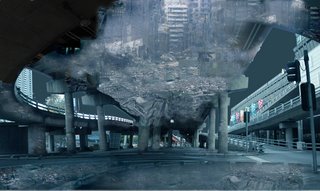
(2) Abattoir of Dreams

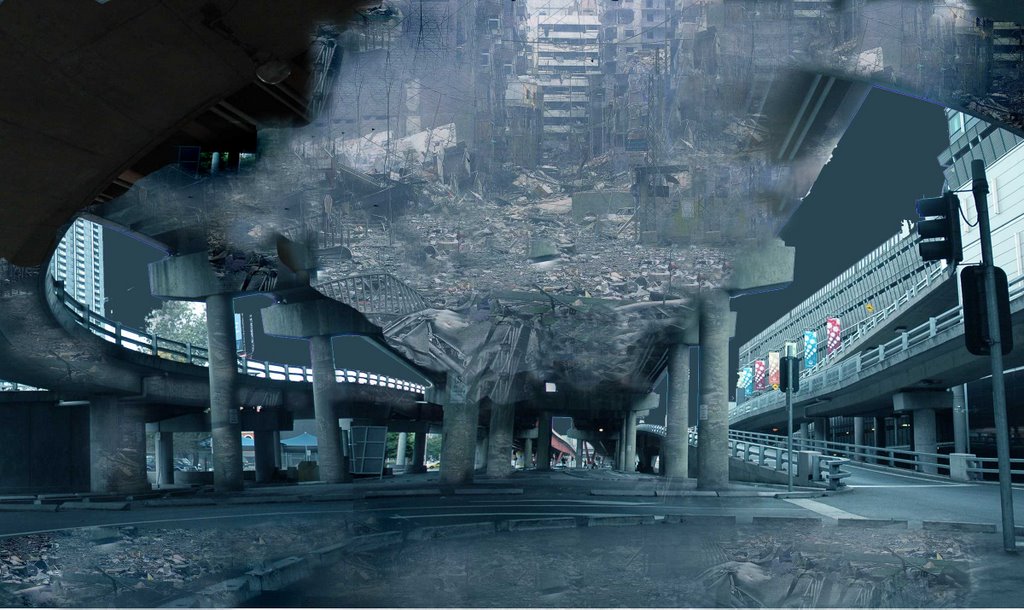
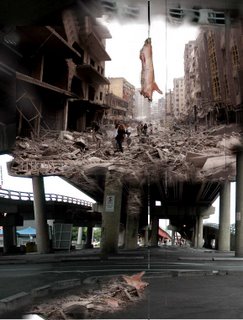
As a culmination to this apparition of violence / mis en scène of horror, one may as well coin a term – glamourhorror: The spectacle of excess co-existing with the reality of death. We come to the Event as commodity: The representation and reproduction of the ‘other world’ as spectacle. The destroyed structure of a city, a symbol of human habitation and industry, existing in parallel time to the modern city we inhabit is projected onto a structure of permanence - a city overpass. The viewer is invited to comprehend the meaning this collision of realities might for them evoke. A sow, offensive to at least two religions is left to swing over the abyss of meaning and the concrete rubble – a lasting symbol to the barbarity of war and the violence of which we collectively remain capable.
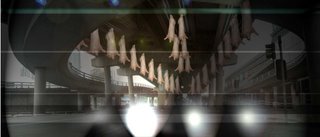
THE WORLD THE SPECTACLE holds up to view is at once here and elsewhere; it is the world of the commodity ruling over all lived experience. The commodity world is thus shown as it really is, for its logic is one with men’s estrangement from one another and from the sum total of what they produce”. p 26. Ch. 2. The Commodity As Spectacle. Ibid

See Jaguar’s work and the work of RMIT and Melbourne University students for one night only, Monday 23rd October, below the Kings Way overpass, at the corner of City Road, Queensbridge Road and Kings Way, as part of the Walk 21 Conference.
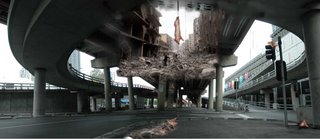


PAST PROJECTS...
| find all projects at STUDIO + SPACE |